
Objectives
Students will:
– Observe that objects are not visible in darkness.
– Understand that light must reflect off objects or be emitted for us to see them.
– Use real-world examples to explain how illumination affects visibility.
Materials
- Flashlights
- Cardboard box
- Familiar small objects (toy, spoon, ball)
- I am using material from the Evan-Moor workbook: Science Lessons and investigations, Grade 1
Books
I like to include a lot of books in my lessons. I am fortunate to have a lot of books available to us at our local library. These are the ones we read for this lesson, but if you don’t have access to these exact ones you can substitute whatever books you feel are appropriate.
- Light: The Extraordinary Energy That Illuminates Our World by Dr. Jess Wade
- Lights Day and Night: The Science of How Light Works by Susan Hughes and Ellen Rooney
What Happens in the Dark?
- We went into a bedroom that had blackout curtains and turned off all the lights.
- We discussed what changed when the lights went off.
“Can you see your hand?”
“What changed when the lights went off?”
“Do we need light to see?”
We read the book, Lights Day and Night: The Science of How Light Works by Susan Hughes and Ellen Rooney. We recreated the game in the book where the kids hide under a blanket in the dark, and I hand them objects to identify.
We added the words to light, energy, illuminate, and light source to our word wall.
- Light: Energy you can see.
- Energy: The power to do work.
- Light source: An object that gives off light.
- Illuminate: To light up.
Box Investigation
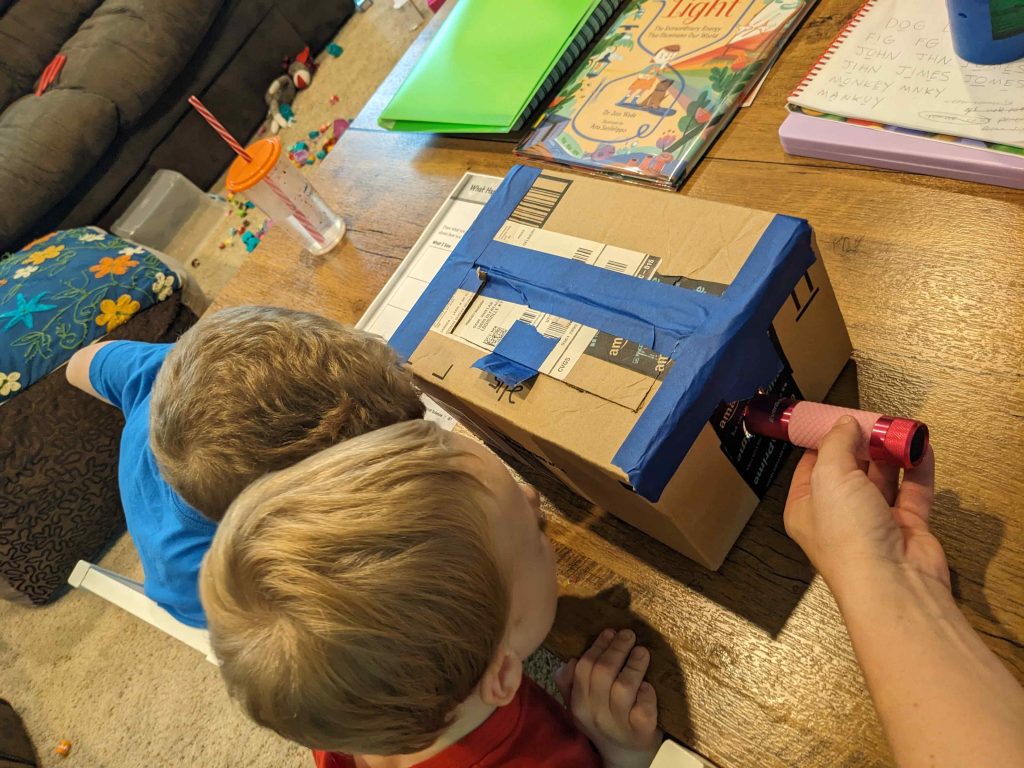
- I prepared a cardboard box with a viewport and a small hole to shine a flashlight into.
- I asked the kids to look into the box and describe what they saw. They couldn’t see anything!
- I turned on the flashlight— they observed how the object inside became visible.
- We recorded our observations on a chart where we specified what we saw and how we saw it. (In the closed and dark box (in cases such as a glow stick), in the box that was closed but illuminated by a flashlight, or in the box with the lid off.)
- Discussed: “What made the object appear?”
We read the book, Light: The Extraordinary Energy That Illuminates Our World by Dr. Jess Wade
We added the words natural, man-made, artificial, and reflect to the word wall.
- Natural: Something that comes from nature.
- Man-made: Something that is made by people.
- Artificial: Something that is made by people.
- Reflect: To bounce off.
Videos
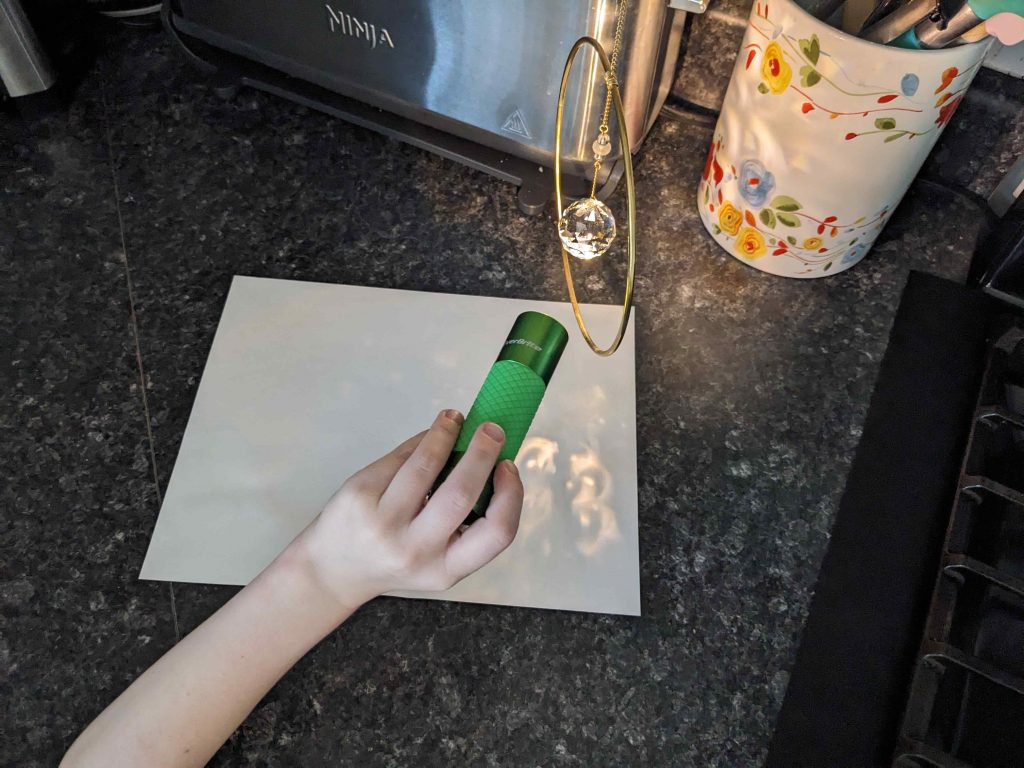
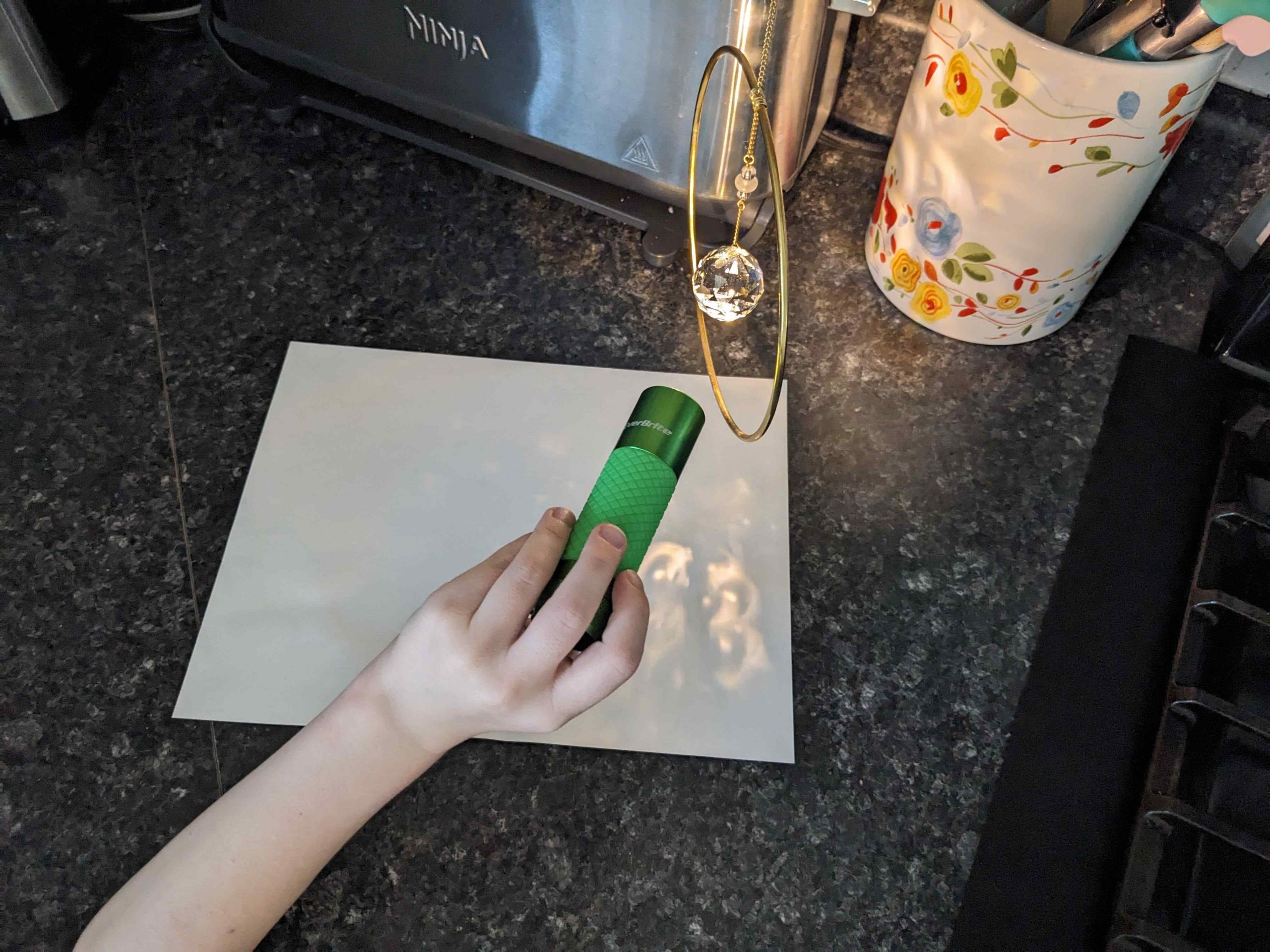
We experimented with shining a flashlight onto a crystal at different angles to see how the light changed. If you get the angle just right, you can even see a rainbow! Which is a great example of how visible light contains all of the colors of the rainbow.
Worksheets
We completed two worksheets from the Evan-Moor workbook that involved answering true/false questions about how light works.
We then played a card matching game from the book, where they matched different light sources to what they were illuminating. (A campfire illuminating a campsite, etc.)
You can download the resources I created for this lesson here:

Leave a Reply